
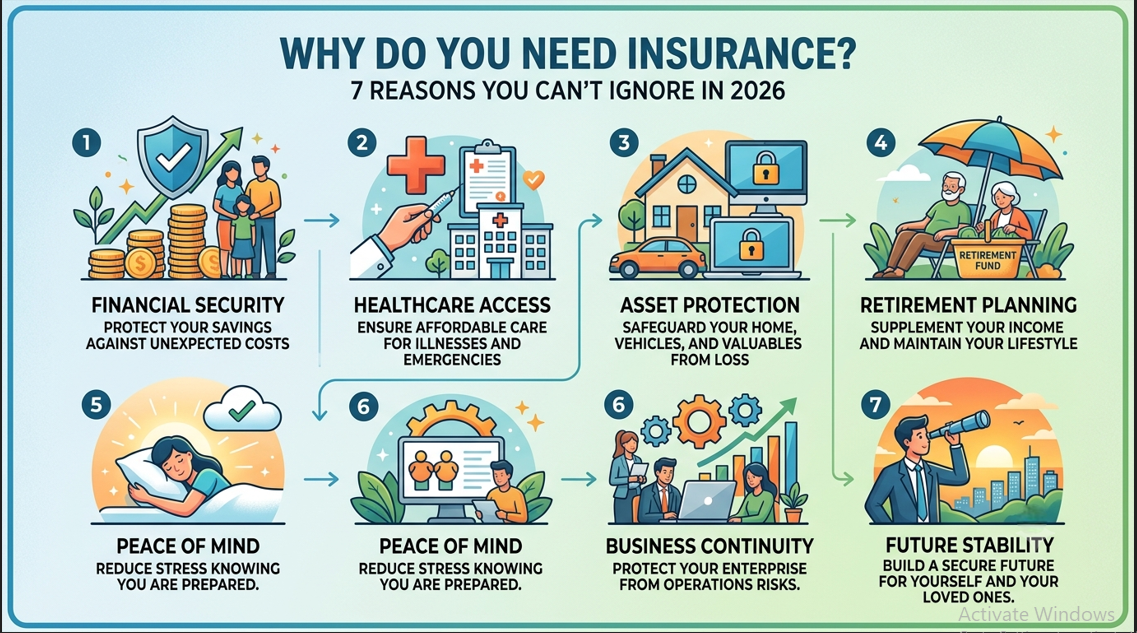
Why Do You Need Insurance? 7 Reasons You Can’t Ignore in 2026
In today’s fast-changing world, financial uncertainty has become a part of everyday life. Medical expenses continue to rise, businesses face new operational risks, natural disasters are becoming more frequent, and legal liabilities are increasing across industries. Whether you are an individual, a business owner, a contractor, or an entrepreneur, one unexpected event can create financial losses that may take years to recover from.
This is exactly why insurance has become more important than ever in 2026.
Insurance is not just a legal requirement or an annual expense—it is one of the smartest financial decisions you can make. It protects your savings, secures your assets, ensures business continuity, and gives you the confidence to focus on your goals without constantly worrying about unexpected risks.
For businesses, especially contractors and infrastructure companies, insurance has evolved from being an optional safeguard to an essential part of project planning. Government tenders, EPC contracts, construction projects, and corporate agreements now frequently require specialized insurance coverage and surety bonds before work can even begin.
In this comprehensive guide, we explore seven compelling reasons why insurance is indispensable in 2026 and how selecting the right insurance strategy can safeguard both your financial future and your professional success.
1. Insurance Protects You from Unexpected Financial Losses
Life is unpredictable.
No one can accurately predict when an accident, fire, flood, theft, machinery breakdown, or medical emergency will occur. Unfortunately, these incidents often come with significant financial consequences.
Imagine situations such as:
- A construction site suffers severe storm damage.
- Expensive machinery is destroyed by fire.
- A vehicle involved in business operations meets with an accident.
- A third party files a compensation claim.
- A manufacturing unit experiences major property damage.
Without insurance, all these expenses must be paid directly from your own resources.
Insurance transfers these financial risks to the insurer, allowing you to recover without exhausting your savings or business capital.
Instead of facing financial uncertainty alone, insurance provides a structured safety net when you need it most.
2. Insurance Helps Businesses Continue Operations
Business interruptions can happen without warning.
Natural disasters, equipment failures, workplace accidents, or liability claims can temporarily halt operations and create substantial financial strain.
For contractors and project developers, even a brief interruption may lead to:
- Project delays
- Contract penalties
- Increased operational costs
- Client dissatisfaction
- Cash flow problems
Appropriate insurance coverage allows businesses to recover more quickly by covering eligible losses and reducing financial disruption.
For engineering and infrastructure companies, specialized insurance products such as Contractors All Risk (CAR) Insurance help protect projects throughout the construction phase by covering accidental physical loss or damage, subject to policy terms and conditions.
Business continuity is no longer a luxury—it is a necessity.
3. Insurance Is Essential for Government Tenders and Infrastructure Projects
One of the biggest reasons businesses purchase insurance today is contractual compliance.
Government departments, public sector undertakings (PSUs), and private infrastructure companies increasingly require insurance before awarding contracts.
Many tenders require:
- Contractors All Risk (CAR) Insurance
- Third-Party Liability Insurance
- Performance Guarantees
- Bid Security
- Surety Bonds
- Advance Payment Bonds
- Retention Money Bonds
Without the appropriate insurance documentation, contractors may become ineligible for project participation.
Properly structured insurance policies ensure compliance with tender conditions and help avoid costly delays during project execution.
Professional guidance becomes especially valuable when policy wording must match project specifications, BOQs, and Letters of Award (LOA).
4. Insurance Protects Your Hard-Earned Assets
Every asset you own represents years of investment.
These assets may include:
- Commercial buildings
- Factories
- Warehouses
- Construction equipment
- Heavy machinery
- Company vehicles
- Inventory
- Electrical installations
Unfortunately, assets remain vulnerable to risks such as:
- Fire
- Flood
- Earthquake
- Theft
- Explosion
- Electrical damage
- Storms
- Accidental impact
Replacing damaged assets entirely from your own funds can severely impact your financial stability.
Insurance helps reduce this burden by providing financial protection against covered losses, enabling faster recovery and minimizing operational disruption.
Protecting assets is ultimately about protecting your future.
5. Liability Risks Are Increasing Every Year
Modern businesses face growing legal and financial responsibilities.
Even when a company follows all safety standards, accidents may still occur.
Examples include:
- Injury to third parties
- Property damage caused during construction
- Product-related claims
- Workplace accidents
- Professional negligence allegations
Legal claims can quickly become expensive due to:
- Compensation payments
- Legal fees
- Court expenses
- Settlement costs
Liability Insurance helps businesses manage these risks by providing financial protection for covered third-party claims, subject to policy terms.
As businesses grow larger, liability exposure grows alongside them.
Ignoring liability risks can have serious financial consequences.
6. Insurance Builds Confidence Among Clients and Investors
Trust is one of the most valuable assets in business.
Clients prefer working with organizations that demonstrate professionalism and responsible risk management.
Having appropriate insurance coverage signals that your business:
- Takes project responsibilities seriously
- Understands risk management
- Is financially prepared for unexpected events
- Values long-term client relationships
- Meets contractual obligations
Financial institutions, investors, and government agencies also tend to have greater confidence in businesses that maintain comprehensive insurance protection.
Insurance reflects preparedness—not uncertainty.
7. Peace of Mind Allows You to Focus on Growth
One of the greatest advantages of insurance is something that cannot be measured in monetary terms: peace of mind.
When your business, assets, employees, and projects are adequately protected, you can focus your energy on:
- Business expansion
- Winning new contracts
- Improving operations
- Investing in innovation
- Serving customers better
Instead of worrying about every possible risk, insurance allows you to plan confidently for the future.
Successful businesses are built not only through profits but also through effective risk management.
Insurance Needs Are Changing in 2026
The insurance landscape has evolved significantly over the last few years.
Today’s businesses require solutions that address increasingly complex risks.
Some of the most important insurance solutions in 2026 include:
Contractors All Risk (CAR) Insurance
Designed for construction and infrastructure projects, CAR Insurance provides broad protection against accidental physical loss or damage during the project period, along with third-party liability cover where included in the policy.
Surety Bonds
Surety Bonds are increasingly replacing traditional bank guarantees in many tenders. They help contractors improve liquidity while meeting contractual obligations.
Common types include:
- Bid Bonds
- Performance Bonds
- Advance Payment Bonds
- Retention Money Bonds
- Regulatory Surety Bonds
Fire & Industrial All Risk Insurance
Protects factories, industrial units, machinery, stock, and buildings against various insured perils.
Marine Insurance
Provides protection for goods in transit through road, rail, sea, or air.
Liability Insurance
Suitable for businesses exposed to third-party legal liabilities, including Commercial General Liability (CGL), Directors & Officers (D&O), and Product Liability Insurance.
Group Health Insurance
Supports employee welfare while helping organizations attract and retain skilled professionals.
Contractor’s Plant & Machinery Insurance
Protects valuable construction equipment against accidental damage and specified operational risks.
Why Professional Insurance Advice Matters
Every business has different risks.
A manufacturing company does not face the same exposures as a civil contractor, and a renewable energy project has different insurance requirements than a commercial building project.
Choosing insurance based solely on price can lead to:
- Coverage gaps
- Claim disputes
- Policy exclusions
- Tender compliance issues
- Inadequate protection
Professional insurance advisory helps businesses:
- Assess project-specific risks
- Compare multiple insurers
- Structure policies according to contract requirements
- Review policy terms and conditions
- Receive assistance during claims
- Manage timely renewals
A well-designed insurance program is built around risk—not simply premium cost.
How Mr. Sushil Yadav Helps Businesses Manage Risk
Mr. Sushil Yadav is an experienced Insurance Marketing Professional (IMD) specializing in engineering insurance and surety solutions for contractors, infrastructure companies, EPC businesses, manufacturing units, and corporate clients.
Based in Etawah, Uttar Pradesh, he provides comprehensive insurance advisory services that include:
- Contractors All Risk (CAR) Insurance
- Surety Bond Solutions
- Tender Documentation Support
- LOA & BOQ-Based Policy Structuring
- Risk Assessment
- Multi-Insurer Quote Comparison
- Claim Assistance
- Renewal Management
Working with leading general insurance companies in India, he helps businesses identify suitable insurance solutions based on project requirements, contractual obligations, and operational risks. His approach focuses on tailored risk advisory, competitive quotations, insurer coordination, and long-term client support.
With the guiding philosophy, “Protecting Projects. Securing Performance. Delivering Confidence.”, Mr. Yadav is committed to helping clients navigate complex insurance needs with clarity and professionalism.
Final Thoughts
Insurance in 2026 is no longer just about recovering from losses—it is about building resilience, ensuring compliance, protecting investments, and enabling sustainable growth. Whether you are an individual safeguarding your family’s future or a business managing complex projects, the right insurance coverage can make a critical difference when unexpected events occur.
The key is not simply to purchase a policy, but to choose coverage that aligns with your specific risks, contractual obligations, and long-term objectives. Thoughtful planning, regular policy reviews, and informed professional advice can help ensure that your protection keeps pace with changing circumstances.
Disclaimer: Insurance is the subject matter of solicitation. Coverage, terms, conditions, exclusions, and claim settlements are governed by the respective policy documents issued by the insurer. IRDAI regulations and applicable registration requirements apply.
Leave a Reply